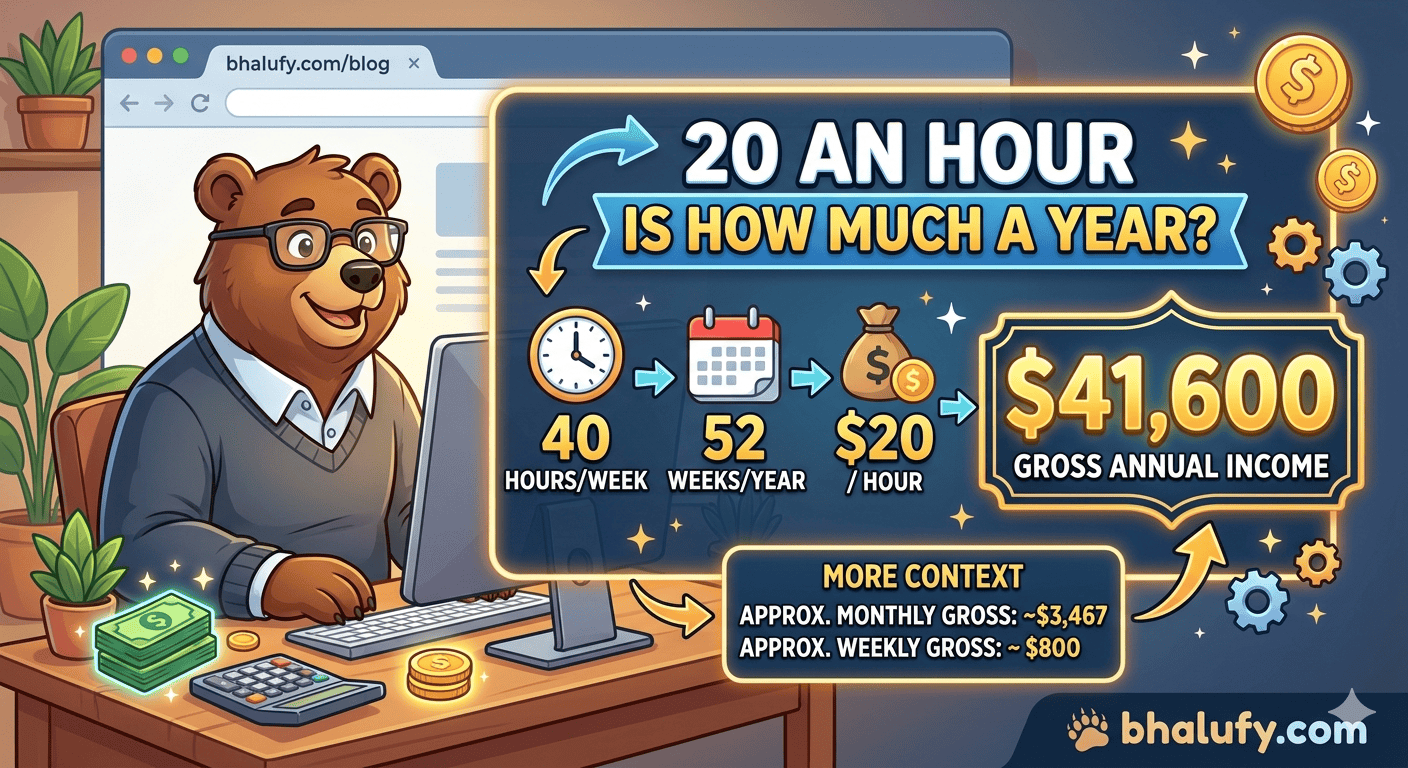
20 an Hour Is How Much a Year? Full Salary Breakdown
If you’ve landed a job paying $20 an hour and want to know exactly what that looks like across a year, a month, or a single paycheck, you’re in the right place. This isn’t just a quick multiplication exercise. Working 40 hours a week for 52 weeks gives you a gross annual income of $41,600. But what you actually take home, and whether that’s enough to live on, depends on a lot more than one number. The Calculator Site like 20 an hour is how much a year and now let’s break it all down.
The Basic Calculation: $20 an Hour Annual Salary
The math itself is straightforward. To convert an hourly wage to an annual salary, multiply your hourly rate by the number of hours you work per week, then multiply that by the number of weeks you work per year.
For a standard full-time schedule:
$20 × 40 hours × 52 weeks = $41,600 per year
That’s your gross salary before a single dollar gets withheld. If you take two weeks of unpaid leave, you’d be working 50 weeks at 2,000 hours, which puts you at $40,000 for the year.
There’s also a handy mental shortcut: double your hourly wage and add three zeros. Double $20 gives you $40, add three zeros, and you get $40,000. It’s a rough estimate, but useful for quick comparisons. Indeed
$20 an Hour Across Every Pay Period
Pay PeriodGross AmountHourly$20.00Daily (8 hrs)$160.00Weekly (40 hrs)$800.00Bi-weekly$1,600.00Semi-monthly$1,733.33Monthly$3,466.67Annual (52 weeks)$41,600.00
The monthly figure assumes around 173 working hours per month, based on approximately 21.67 workdays. OysterLink
Take-Home Pay: What You Actually Pocket After Taxes
Gross pay and take-home pay are two very different things. Your $41,600 salary will shrink once the government takes its share.
For a $20/hour worker paid bi-weekly, deductions per check break down like this: federal income tax is roughly $113.60 (based on 2025 brackets after the $15,000 standard deduction), Social Security takes $99.20 (6.2%), and Medicare takes $23.20 (1.45%). That comes to about $236 in total federal and FICA deductions per bi-weekly paycheck, leaving an estimated net take-home of $1,364.
Scaled up to a full year, after federal taxes and typical deductions, you’d likely take home somewhere between $32,000 and $35,000. The exact amount depends on your state taxes and personal financial situation. SoFi
State taxes make a big difference. Nine U.S. states don’t impose their own income tax for 2025 and 2026. If you live in Texas, Florida, Nevada, Washington, Wyoming, South Dakota, Alaska, Tennessee, or New Hampshire, your take-home will land toward the higher end of that range. Residents of California, New York, or Oregon will see noticeably more withheld.
Estimated Annual Take-Home by Scenario
SituationEstimated Take-HomeNo state income tax (e.g., Texas, Florida)~$34,000–$35,000Average state income tax~$32,000–$33,500High-tax state (e.g., California, NY)~$30,000–$32,000
These are estimates. Your actual number shifts based on your W-4 elections, any pre-tax deductions like a 401(k) or health insurance, and whether you claim dependents.
How Does $20 an Hour Compare to US Averages?
This is where context matters a lot.
The average hourly pay for an American worker sits at $31.18 as of May 2025, per Bureau of Labor Statistics data. The median US salary is $62,192, meaning $41,600 represents about 66.9% of that median figure. The Calculator Site
The median salary in the US is $77,719 per year, putting $20 an hour at roughly $36,000 below that benchmark. The average wage now sits at $35.70 per hour, leaving $20/hr about $15.70 below the average. Inch Calculator
That doesn’t make it a bad wage, though. It’s well above the federal minimum of $7.25 and beats most state minimums, which range from $8 to $15 an hour. The real question is whether it covers the cost of living where you are.
Is $20 an Hour Enough to Live On?
The honest answer is: it depends entirely on your location and household situation.
MIT’s Living Wage Calculator, updated February 10, 2025, is one of the most widely cited tools for answering this. The national living wage for a single adult with no children is currently $19.44 per hour. That means $20 an hour technically clears the national living wage bar for a single adult, but only just. mit
The moment you factor in geography, that margin shrinks fast.
The living wage for a single individual in Washington D.C. sits at $20.80 an hour. In New York, a single person needs $20.05 an hour to cover the minimum standard of living. At $20 flat, you’d be falling short in both of those places. World Population Review
In states with a lower cost of living, like Kentucky, the living wage for a single adult is $14.16 per hour, so $20 an hour leaves real breathing room. World Population Review
The family picture is more sobering. A single adult with one child needs a living wage of $31.82 per hour at the national level. Two adults sharing expenses with no children need $13.66 each if both are working. If you’re supporting kids on $20 an hour solo, the math gets hard in most parts of the country. mit
$20/Hr Living Wage Comparison by Location
Location Wage (Single Adult)$20/Hr average$19.44AboveLow-cost states (e.g., KY, MS, WV)~$14–$16Comfortably aboveMid-cost states (e.g., OH, IN, TX)~$17–$19Slightly aboveHigh-cost cities (NYC, SF, DC)$20.05–$20.80+At or below
What Jobs Pay $20 an Hour?
You don’t need a four-year degree to reach this wage. A recent Indeed breakdown confirms that skilled trade and service positions regularly start at or above $20/hr, with many topping $40/hr as experience builds. Savings Grove
Some roles commonly found at or around $20 an hour include:
Food delivery driving through platforms like DoorDash and Uber Eats can reach or exceed $20 an hour depending on location and hours worked. Freelance writing, bookkeeping, and proofreading are other accessible paths that regularly pay at this level. Millennial Money Man
In the medical field, pharmacy technician roles, medical coding, patient case management positions, and customer service jobs in healthcare often advertise at $20 per hour. Virtual assistance, graphic design, web development, and online tutoring are common remote roles that hit this mark without requiring a traditional degree.
Skilled trades, logistics, and manufacturing are reliable sources too. Truck drivers, HVAC technicians, and warehouse supervisors frequently land above $20 an hour after even modest experience.
How Overtime Affects Your Annual Total
If your job offers overtime, your annual income can grow quickly. Most employers pay overtime at 1.5 times the regular rate for any hours worked beyond 40 in a week. At $20 an hour, that’s $30 per overtime hour.
Working just five hours of overtime per week year-round adds roughly $7,800 to your gross annual pay, pushing your total to about $49,400. Ten weekly overtime hours would bring you close to $57,200. Those numbers change the calculus of $20 an hour considerably.
Part-Time Scenarios at $20/Hr
Not everyone works full-time. At 20 hours per week, your gross annual salary drops to $20,800. The table below shows how hours worked per week affects your annual gross: Good Financial Cents®
Hours Per WeekAnnual Gross (52 weeks)20 hrs (part-time)$20,80030 hrs$31,20040 hrs (full-time)$41,60045 hrs (5 hrs OT/wk)$49,40050 hrs (10 hrs OT/wk)$57,200
Budgeting on a $20 an Hour Salary
Say you’re taking home approximately $2,955 per month after federal taxes in a no-state-income-tax state. How should that get divided?
NerdWallet and most financial planners point to the 50/30/20 rule as a starting framework: 50% toward needs, 30% toward wants, and 20% toward savings or debt repayment. Applied to a $2,955 monthly take-home:
Budget CategoryMonthly AmountNeeds (50%)$1,477Wants (30%)$887Savings/Debt (20%)$591
The rent portion of that “needs” bucket is where things get tight in many markets. The national median asking rent for a one-bedroom apartment sits well above $1,200 in most metros. If housing eats half your take-home, you’re already departing from this framework.
That’s not a reason to panic. It’s a reason to be deliberate. Workers earning $20 an hour who build a roommate arrangement, live in lower-cost areas, or pick up additional income streams can make the numbers work very well.
$20 an Hour in a Global Context
For international readers, it’s worth noting that $20 USD per hour is a strong wage in most of the world. The US federal minimum wage of $7.25 is itself higher than the legal minimum in many countries when adjusted for purchasing power.
Exact figures vary by region and currency. Anyone comparing wages internationally should factor in local costs, healthcare systems, and social safety nets, all of which dramatically affect what an hourly wage actually means in practice.
FAQ
$20 an hour is how much a year for a full-time worker?
$41,600 gross, based on 40 hours per week across 52 weeks. With two weeks unpaid leave, that drops to $40,000.
What is the monthly salary for $20 per hour?
At $20 an hour working 40 hours per week, your monthly salary comes to $3,466.67.
What is the weekly pay at $20 an hour?
Working a standard 40-hour week at $20 an hour gives you $800 per week.
How much is $20 an hour after taxes?
After federal taxes and typical deductions, most people earning $20 an hour take home roughly $32,000 to $35,000 per year, varying by state and personal circumstances
Is $20 an hour a living wage?
At the national level, the MIT Living Wage Calculator sets the living wage for a single adult with no children at $19.44 per hour as of February 2025, so $20 an hour clears that threshold nationally. In higher-cost cities, it may not be enough
What is $20 an hour bi-weekly?
A bi-weekly paycheck at $20 an hour totals $1,600 gross, based on 80 hours of work over two weeks.
If you’re evaluating a job offer at $20 an hour, the gross annual figure of $41,600 is just the starting point. Run the numbers for your specific state taxes, factor in any benefits that come with the role (health insurance and a 401(k) match add real dollar value), and honestly assess your local cost of living. In smaller cities and lower-cost states, this wage affords a stable, comfortable life for a single adult. In San Francisco or New York, it’ll require serious planning or additional income. The number itself is neutral; what matters is the full picture around it.
